UK sleep in 2026 is a public-health issue, not just a lifestyle complaint. Recent UK survey data suggests many adults are getting too little good-quality sleep, and stress, worry, and mental health pressures are strongly linked to poor rest. For a health blog, the strongest angle is to explain the numbers clearly, show what they mean, and then connect the data to practical sleep advice and NHS guidance.
Why sleep matters
Sleep affects mood, concentration, immunity, and the ability to function well during the day. The NHS says that if someone cannot get to sleep or stay asleep long enough to feel refreshed, they may have insomnia, and it can last for months or even years. The NHS also notes that poor sleep can affect daily life, make people irritable, and reduce concentration. That is why sleep statistics are useful: they show how widespread the problem is and why it matters beyond feeling tired.
The latest UK figures
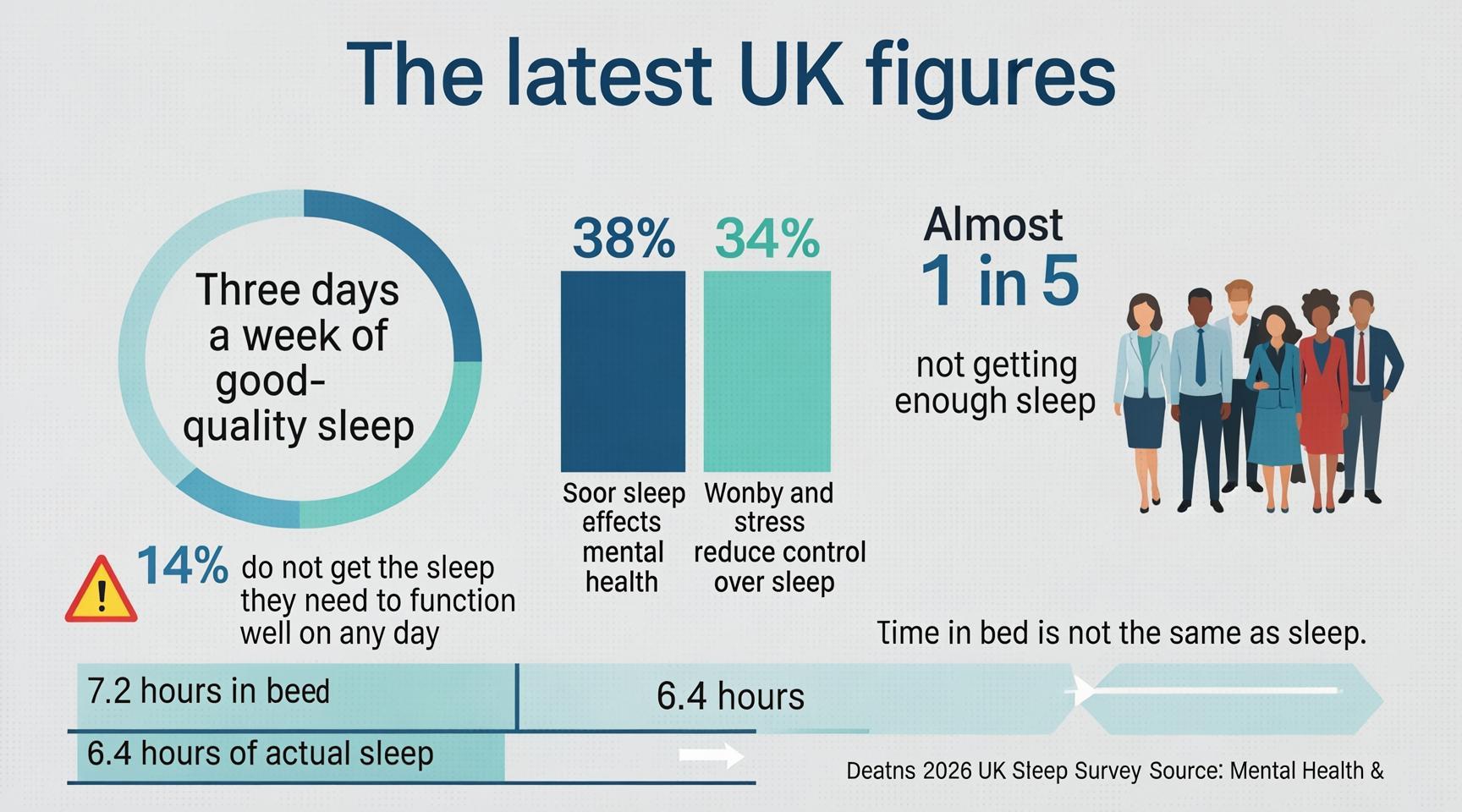
The clearest 2026 UK sleep figures come from recent surveys and health charities. The Mental Health Foundation reported that the average UK adult gets only three days a week of good-quality sleep, based on a survey of 2,000 UK adults. It also found that 14% of adults say they do not get the sleep they need to function well on any day in a typical week. In the same survey, 38% said poor sleep affects their mental health at least once a week, and 34% said worry and stress reduce their control over sleep.
Mental Health UK adds that almost 1 in 5 people in the UK are not getting enough sleep. That makes sleep loss feel less like an individual problem and more like a widespread UK issue linked with stress, finances, and mental wellbeing. Dreams’ 2026 UK Sleep Survey found that adults spend 7.2 hours in bed but get only 6.4 hours of actual sleep on average. That gap matters because time in bed is not the same as sleep, and it explains why people can still feel drained even when they think they have “slept long enough”.
What the numbers mean
These statistics point to a consistent pattern: sleep quality is being damaged by modern stress, and many people are not reaching the sleep they need to feel restored. The Mental Health Foundation survey is especially striking because it does not just measure hours in bed; it shows how often people say they actually get good sleep. In plain English, the UK sleep problem in 2026 is not simply short sleep, but unreliable and low-quality sleep.
A blog built around these numbers should avoid sounding alarmist. Instead, it should explain that poor sleep is common, often caused by a mix of emotional and practical factors, and usually improves when the underlying cause is addressed. That makes the article useful to readers and also more credible for search engines because it is specific, balanced, and grounded in evidence.
Who is most affected
The 2026 Dreams survey suggests younger adults are strongly affected by mental-health-related sleep disruption. It reported that 38% of 18–24s and 38% of 25–34s said mental health affects their sleep, compared with lower levels in older age groups. That is a useful point for your blog because it shows that sleep problems are not limited to older adults or people with diagnosed insomnia; they are also common among younger people living with stress, work pressure, or digital overload.
The Mental Health Foundation and Mental Health UK both point toward stress and worry as major drivers. Mental Health UK says money worries affect sleep for a significant share of adults, and stress is a recurring factor in poor sleep patterns. That means a strong article should include lifestyle, emotional, and financial causes rather than treating sleep as a purely medical issue.
Common causes
The NHS lists several common reasons for sleep problems, including stress, anxiety, depression, noise, an uncomfortable bedroom, alcohol, caffeine, nicotine, jet lag, shift work, and certain medical conditions. It also says problems such as sleep apnoea, restless legs syndrome, menopause, and some medicines can interfere with sleep. This is important because many readers search for “sleep statistics” when what they really need is an explanation of why they cannot sleep.
A good long-form blog should group causes into simple categories:
Lifestyle causes, such as caffeine, screens, late nights, and irregular sleep routines.
Emotional causes, such as stress, worry, anxiety, and low mood.
Medical causes, such as sleep apnoea, restless legs, pain, or hormone changes.
Work and routine causes, such as shift work or travel across time zones.
This structure makes the article easier to read and easier for Google to understand.
Sleep and mental health
The link between sleep and mental health is bidirectional. Mind explains that sleep problems can worsen mental health, and mental health problems can also make sleep harder. The Mental Health Foundation survey also found that many adults say poor sleep affects their mental health every week. That creates a feedback loop: worry makes sleep worse, and poor sleep makes worry feel harder to manage.
For your article, this section should be written carefully. Avoid claiming that every sleep problem is caused by mental health, but do explain that stress, anxiety, and low mood are among the most common and important contributors. That keeps the tone human and accurate.
Symptoms of insomnia
The NHS says insomnia may involve difficulty falling asleep, waking several times during the night, lying awake at night, waking early and not being able to go back to sleep, still feeling tired after waking, irritability, poor concentration, and difficulty napping even when tired. It also says that if poor sleep is affecting daily life or causing distress, people should speak to a GP or call NHS 111. This is useful in a statistics article because it connects the headline numbers to real-world symptoms people can recognise.
It is also worth explaining the difference between short-term and long-term insomnia. The NHS says insomnia lasting less than 3 months is short-term, while insomnia lasting 3 months or longer is long-term. That distinction helps readers know when sleep troubles may need professional help rather than just self-care.
Health impact
Poor sleep is not harmless. The NHS says long-term sleep problems can affect relationships, social life, energy levels, eating habits, concentration, and the ability to carry out daily tasks. In practical terms, that can mean being less productive at work, reacting more slowly while driving, or feeling emotionally worn down. For many readers, this is the part that makes the statistics feel real.
You can also frame the health section around day-to-day functioning rather than only medical risk. Readers often connect more with “I can’t focus in meetings” or “I feel exhausted with my children” than with abstract health language.
How to sleep better
The NHS recommends several practical sleep-hygiene steps: go to bed only when sleepy, wake up at the same time every day, relax before bed, make the bedroom dark and quiet, exercise regularly, and avoid caffeine, alcohol, smoking, and screens late in the day. It also advises not to nap during the day and not to lie in after a bad night, because a consistent sleep pattern helps the body clock. These tips are simple, but they are exactly what readers expect from a high-quality, research-based sleep article.
A useful way to present this in the blog is as a short checklist:
Keep a fixed wake-up time.
Build a calm pre-bed routine.
Reduce screen use before sleep.
Avoid late caffeine and alcohol.
Keep the bedroom cool, dark, and quiet.
Get medical help if problems continue.
FAQ
Is 6.4 hours of sleep enough?
For most adults, no. The NHS says a healthy adult usually needs around 7 to 9 hours of sleep, although individual needs can vary.
Is poor sleep the same as insomnia?
Not always. Insomnia usually means having trouble falling asleep, staying asleep, or waking feeling unrefreshed on a regular basis.
What is the biggest reason people in the UK sleep badly?
Recent UK survey data points strongly to stress and worry, especially around mental health and money.
When should someone see a GP?
The NHS says people should see a GP if changing sleeping habits has not helped, if sleep problems have lasted for months, or if poor sleep is affecting daily life.
References
Mental Health Foundation. Average adult has only 3 days a week with good quality sleep.(1)
Mental Health UK. Sleep and mental health.(2)
Dreams. The 2026 UK Sleep Survey.(3)
NHS. Sleep problems.(4)
NHS. Insomnia.(5)
Mind. Sleep and mental health.(6)